Samaná Fest
Words: Camille Langen, Mael NGuyen & Jules Dominé | Photography: Camille Langen & Jules Dominé
15 May 2026
Racing & advocating for Antioquia’s rivers rivers rivers rivers

In the jungle canyons of Colombia, not far from Medellín, where the Andes break into a dense network of rainforest and whitewater, a whitewater festival of a rarespecial kind takes place.Created ten years ago by French paddlers Jules Dominé and Mael NGuyen, the Samaná Fest is a ten-day gathering built around a 40 km Class IV-V marathon, bringing together international paddlers, local communities, artists, and conservationists. Competitive or not, participants join the event to race, celebrate, defend, and raise awareness, and to share the river itself, rafting sections alongside local communities, to help keep the rivers of Antioquia wild.
“ The forty kilometers of Class IV and V ahead stand as both challenge and privilege. ”
In the lush jungle canyon, usually filled with birdsong and the low murmur of distant rapids, a shout suddenly erupts: “Samaná libre!”The dark sand beach, uncovered by the night’s flow, has turned into a vivid mosaic of kayaks, their colors lining the riverbank in the depths of Colombia. Thirty determined kayakers from all around the world prepare for what may be the longest, and perhaps the hardest, whitewater race on the planet.Behind this pretentious title lies a far more noble purpose, though, and a harsh reality. The race only exists because the river still runs free, but that freedom is under threat. No one on the starting line is here just to race; there is a real motivation to go beyond kayaking and remind us that this sport, this hobby, this passion unites us not in finding out who is the fastest on the water, but in our shared love for rivers.Threatened for decades by hydropower projects, the Samaná watershed, one of the most biodiverse in the world and home to an extraordinary concentration and diversity of whitewater, remains the last in the region to flow freely. The battle for its survival has always been pressing, yet a rare mix of tourism, sports, and local communities has managed to slow the progress of the dams. That is what brings us here.

The forty kilometers of Class IV and V ahead stand as both challenge and privilege.The countdown begins, the whistle blows. The pack launches forward at once, exploding, bubbling, erupting with raw energy, just like the river itself.Everyone knows the drill: stick to the lead group without burning out too early, because the road ahead is long. Within minutes, the front pack breaks away. Michele Ramazza, last year’s winner and top favorite; Breiner Matiz, the Colombian machine who shone during qualifications; Jules Dominé, the first person to descend the Samaná; and Daniel Klotzner. At the last second, Mael NGuyen latches onto Daniel’s wash and manages to stay in the game. Behind, the rest of the group stretches out as each paddler finds their own pace in harmony with the river flow. This is as much a mental race as a physical one. To last the distance, racers have to let go of their own habits and move in complete symbiosis with the river. How are they meant to hold this for 40 kilometers? And why is it so long anyway?
Samaná libre, a powerful slogan

“ Samaná Fest is a ten-day festival and whitewater race held each year in Antioquia, Colombia. Split across two weekends to involve local communities, the days in between revolve around kayaking. At its center sits the marathon, the longest whitewater race in the world. ”
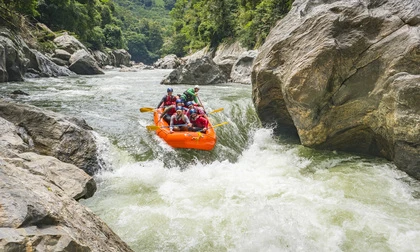
The event was created with a simple desire: to show the Samaná’s beauty and engage people in its protection. What started as a rafting trip with local leaders has grown into an international festival that attracts paddlers from dozens of nationalities and invites them to join rural communities, local politicians, scientists, and artists in shouting “Samaná Libre!” The program innovates every year, but it remains rooted in adventure sports and kayaking, blending it with art, music, tourism, and community to amplify the river’s voice.The festival opens with a stoke float, where kayakers and locals descend together before arriving at a riverside hamlet. A gathering on the bridge, symbolizing both access to the river and the risks that come with it, marks the start of the event. By night, the same place fills with music, with international DJs playing where the marathon will begin a few days later.This year introduced a three-discipline relay linking kayaking, paragliding, and trail running in the waterfalls valley of Antioquia. Conceived around the idea of continuity, it reflects the need for the river to remain connected from its headwaters to the plains. Runners climb steep trails before handing off to paragliders, who launch above the clouds and glide along the waterfalls that feed the valley. As the river forms below, kayakers take over, racing the final stretch on the Santo Domingo. The spectacle is impressive. Each team covers eight kilometers of Class IV whitewater, ten kilometers of trail with 800 meters of elevation gain, and a precision flight through one of the most stunning landscapes.Qualifiers for the whitewater marathon take place on the Cocorná, a more accessible river lined with cheering crowds. This event stays open to all levels, with a beginner race welcoming anyone who shares a love for the river.After the qualifiers, a full day is dedicated to exploring the Samaná. In a relaxed atmosphere, paddlers and locals descend together in kayaks and rafts, then return in chivas, the open, brightly painted buses that bounce along dirt roads with reggaeton echoing through the hills. The day before the marathon, meant to be a rest day, is also a chance for the most motivated to go big, descending sections like Gracias a Dios on the remarkable Calderas River.

Last rapid of the Samaná River during the finals only accessible to the top fifteen kayakers
The marathon is the most challenging event of the week. It is run on a section of the Samaná that has no road access throughout the race, cutting through one of the most pristine and inaccessible jungle corridors in the country, home to plant and animal species found nowhere else. The race begins near the only accessible bridge, by the village of San Luis, then drops into a remote stretch fed by tributaries descending from the páramos, the high-altitude ecosystems of the Andes. It finishes at Puerto Garza, the only small community along the river. The Samaná was supposed to be dammed and flooded by 2018, and yet it still runs. Racing here feels like both an act of resilience and integrity. Finish in the top ten, and a place in the epic finals awaits in the last canyon, a short but intense descent through three demanding rapids, the last of which requires the most precision, just beneath waterfalls that spill from the forest into the river. But just being here already means taking part in something much larger: keeping the Samaná free-flowing.

Qualifier races during Samaná Fest
A community celebration
Puerto Garza hosts the closing celebration on the last day. A signature parade advocating for the protection of the river is held in the streets, with kayakers, local kids, sax players, town representatives, and fishers all taking part. The village’s most skilled fishermen throw nets into the busy street, catching a few smelly paddlers as everyone laughs at the scene. Marching towards the bridge, a symbolic moment of unity forms above the river. Dirtbag kayakers hug the village abuelitas, while the soldiers ensuring security let their guard drop for a second, their faces softening as their fingers ease off the trigger, cracking a smile as they take in the powerful scene.By late afternoon, Puerto Garza’s main street fills with dripping lifejackets, helmets, and abandoned paddles. Half a dozen languages spill out from the local bar, and in this remote riverside village, it is rare. World-class paddlers share a beer with local fishermen around the same plastic table. Not the kind of image one might usually associate with river protection, and yet, it is precisely in settings like this, looking over the same river, that conversations have the most power. Samaná Fest was born in these same villages, with these same communities, through the ideas of Jules Dominé and Mael NGuyen. The presence of an international crowd only makes its message more powerful and visible.As people gather around the stage, there is a mix of excitement, joy, and power in the air. The mayor of Puerto Garza speaks to the crowd:

“ This land is made of farmers! Of nature! Of rivers! That we all need to protect. For this reason, we are standing firm for the defense of our rivers! We are standing firm so that our rivers continue to remain free! ”
Behind him, a waterfall plunges straight from the forest into the river whose future remains uncertain. Standing there, it feels impossible not to grasp why people from all over the world have come so far to defend this river.
Concerts on the last night of the Samana fest animating the streets of Puerto Garza
The festive atmosphere carries a deeper message, echoed by the artists on stage: Afaz Natural, Killa Beat Maker, Santo Stereo, Sonido Chapa, Charcano, and Trópico Negro, all use their voices in defense of the Samaná. Based on the rhythms of cumbia, the concerts showcase a mix of electro and Afro-Caribbean beats, with several artists performing original songs written specifically to protect the river. Locals smile at the scene. There is something genuinely entertaining about watching some of the best kayakers in the world, so graceful on the river earlier that day, now far less at ease moving to cumbia rhythms. The effervescence of the concerts, the final event of Samaná Fest after ten days of competition and community gatherings, carries on late into the night. It is crazy what a free-flowing river can do.
Keeping the Samaná free

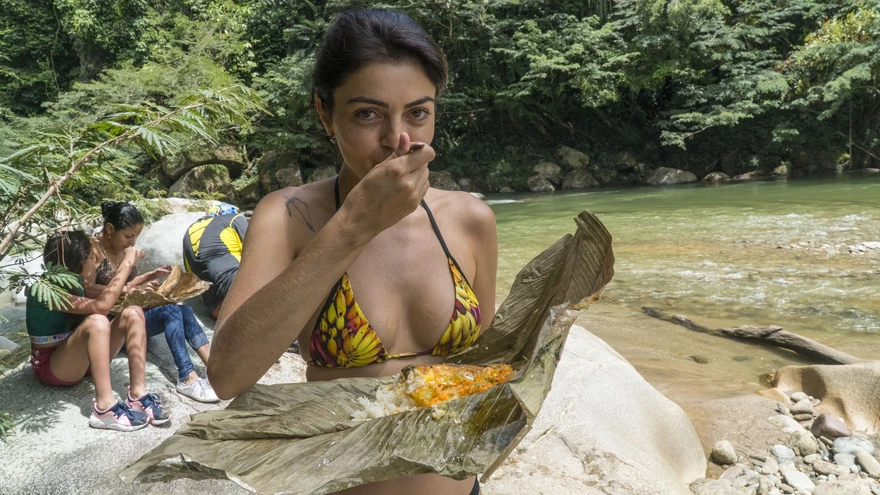
As the light flickers around the dance floor, it is easy to wonder where that energy comes from. Most of Colombia’s electricity is sourced from hydropower, meaning that nearly every light is powered by a river that once flowed freely. So many ordinary moments during the festival serve as reminders that everything is tied to irreplaceable resources that the Earth provides.The watershed is currently under threat from eight new hydroelectric projects. After the failure of the mega-project Porvenir 2, the strategy has shifted toward proposing multiple micro-plants across all its tributaries. “To save the river, you have to be in the river.” Through a range of actions, Samaná Fest brings attention to these endangered streams, from raft descents on the Río Verde and Río Calderas to marathon qualifiers on the Río Cocorná and a triathlon on the Río Santo Domingo. This year’s edition also included guided raft descents, giving locals the chance to experience the river.As locals guide visiting paddlers around the village, making sure they are well fed between dances, the thought of the river as a source of energy lingers. Perhaps the real power of the Samaná is not in producing electricity, but in creating connections between two worlds that would otherwise never meet, and in doing so, strengthening the effort to protect it.Warmth, openness, and generosity are words visitors consistently use to describe the local communities. Samaná Fest integrates these values by placing inclusion at its core, ensuring that communities receive from the river. This includes new initiatives such as the Students for Rivers Camp in September 2026, in collaboration with the River Collective. This youth-led program brings together Colombian and international university and PhD students to work across disciplines on the protection of the Samaná, combining scientific and legal approaches. Students, scientists, activists, experts, lawyers, and policymakers will collaborate on a legal proposal for the river’s protection, as well as on conducting novel research on endemic species within the watershed ecosystems to strengthen its recognition in policy and decision-making spheresThe invitation to come to Samaná Fest is, of course, an invitation to enjoy this extraordinary place, but also to awaken something deeper inside kayakers, who spend much of their time on the water and deeply cherish those moments of freedom, and to give something back in return: a commitment to protecting the freedom of rivers, wherever they may flow What Jules has created is precious, and with the help of Mael and the whole Samaná community, this has become the battle of their lives, one they might just win if they keep fighting.. Save a river, and enrich a community through diversity and connection. In a world where division becomes the norm, Samaná Fest stands as a proof people can unite building something meaningful without needing to share the same language, religion or culture. The battle to keep the Samaná free-flowing shows what can be done when people choose to take positive action rather than pure opposition. Samaná Fest creates a space that brings people around what they love, allowing meaningful connections and movements to be born from the festival. After decades of fighting, a new movement is developing across all levels of society, moving from protecting the last free-flowing river in the region to making it the first legally protected river in Colombia.

Jules Dominé, founder of the Samaná fest, going down the Santo Domingo River